
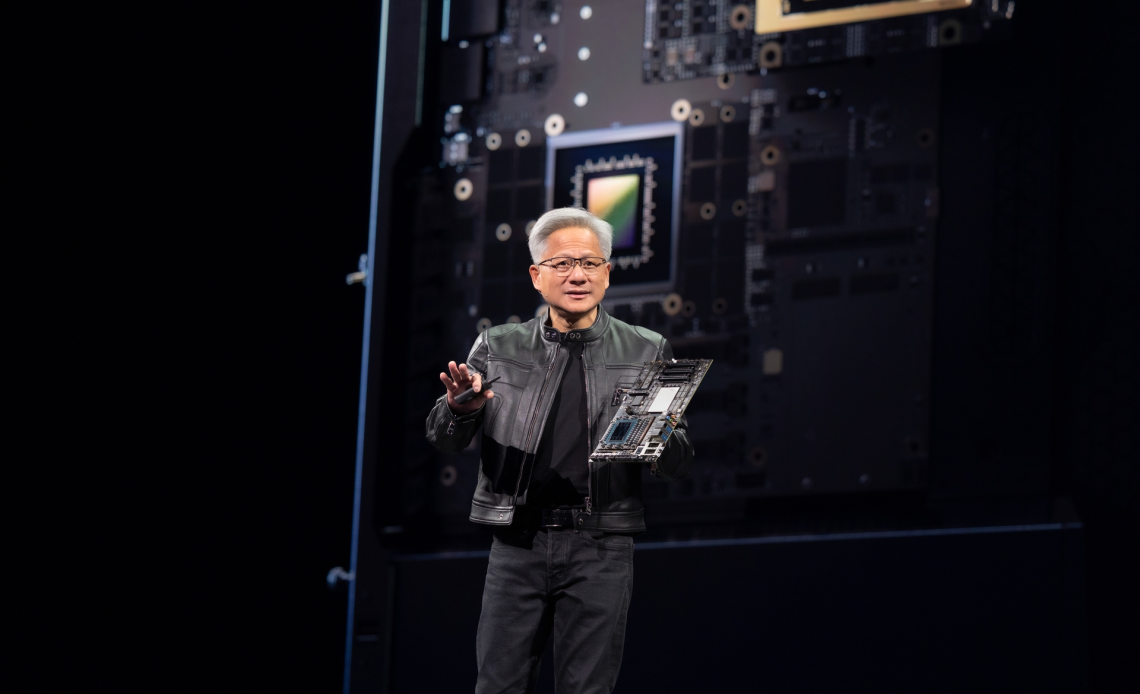
Nvidia (NVDA) stock fell on Friday as investors weighed a stronger-than-expected US jobs report, weakness across semiconductor stocks, and lingering questions about the company’s newest growth initiatives unveiled at Computex.
Shares of the AI chipmaker dropped 3.6% to $210.04 in early trading, leaving the stock little changed from where it began the week.
The moves come despite a series of announcements in Taiwan, including the launch of a new processor aimed at the personal computer market.
The decline came as semiconductor stocks broadly came under pressure.
The S&P 500 fell 1%, while the Nasdaq Composite dropped 1.6%. The Dow Jones Industrial Average was down 151 points, or 0.3%.
Among chipmakers, Broadcom fell about 3% after plunging more than 12% on Thursday.
Marvell Technology dropped more than 8%, while Micron Technology declined 6%.
Investor sentiment was also affected by stronger-than-expected labor market data.
The Bureau of Labor Statistics reported that nonfarm payrolls increased by 172,000 in May, well above economists’ expectations for 80,000 new jobs. The unemployment rate remained unchanged at 4.3%.
Computex announcements fail to spark sustained rally
Nvidia entered the week with momentum following the unveiling of its RTX Spark processor, a chip designed for AI-powered personal computers.
However, those gains faded as investors assessed the commercial potential of the new product category.
While the PC processor launch was one of Nvidia’s highest-profile announcements at Computex, the market opportunity remains largely untested.
Investors appear to be waiting for evidence that consumers will embrace premium devices capable of running AI agents directly on the device.
The cautious reaction reflects a broader theme surrounding Nvidia’s expansion efforts.
While the company dominates the market for AI accelerators used in data centers, investors are seeking proof that newer businesses can become meaningful contributors to future growth.
Nvidia qualifies HBM4 suppliers
Away from the stock market reaction, Nvidia continued to strengthen its next-generation AI supply chain.
Chief Executive Officer Jensen Huang confirmed that Nvidia has qualified all three leading memory manufacturers — Samsung Electronics, SK Hynix, and Micron Technology — to supply high-bandwidth memory, or HBM4, for the company’s upcoming Vera Rubin AI platform.
“All three vendors have been qualified,” Huang told reporters upon arriving in Seoul. “All three vendors are in production, and they’re all racing to support Vera Rubin.”
HBM4 is expected to play a critical role in Nvidia’s next-generation AI systems.
Huang said this week that Vera Rubin is already in full production and remains on track for deliveries beginning in the third quarter.
The systems combine Nvidia’s Vera central processing units and Rubin graphics processors with large amounts of HBM4 memory within each server system.
The importance of memory supply has become increasingly evident across the semiconductor industry.
Arm Chief Executive Officer Rene Haas said this week that memory has emerged as “probably the toughest” bottleneck to resolve.
Nvidia has underscored the importance of its memory partners throughout Computex.
In Taipei earlier this week, Huang hosted a dinner with executives, including SK Group Chairman Chey Tae-won and SK Hynix Chief Executive Officer Kwak Noh-jung, highlighting the critical role memory suppliers play in Nvidia’s AI ecosystem.
Analysts remain bullish
Despite recent share price weakness, Wall Street remains broadly positive on Nvidia’s long-term outlook.
Earlier this week, Morgan Stanley reiterated its Overweight rating and maintained a $288 price target on the stock, while continuing to identify Nvidia as its top pick within the processor sector.
The firm said Nvidia remains attractively valued relative to its growth prospects and highlighted the company’s expanding presence beyond graphics processors.
Following discussions with management and investor meetings during Computex, Morgan Stanley pointed to Nvidia’s growing opportunity in central processing units.
According to the firm, Nvidia executives indicated the company has visibility into approximately $20 billion of CPU-related revenue opportunities.
Morgan Stanley also highlighted Nvidia’s efforts to improve the economics of AI infrastructure deployments.
The firm noted that approximately half of the total cost of ownership for AI factories is associated with head-node systems and said Nvidia’s ability to lower those costs could become an important catalyst for future investor sentiment.
For now, however, investors appear content to wait for further evidence that Nvidia’s expanding CPU business and broader AI infrastructure offerings can develop into significant growth engines alongside its dominant GPU franchise.
The post Nvidia stock crashes another 3% today: why Computex failed to spark a rally appeared first on Invezz